For football academies

Your GPS measures what the body did. Nothing measures what it cost.

Forta is the internal half of load monitoring — a ten-second morning check-in that gives every player a readiness score before staff write the session. No vests. No straps. The phone they already own.

272 movements scored10 seconds per playerno hardware

The problem

Two players cover the same 10km. One is fine on Friday. One is finished.

Your GPS reads them identically, and it is right to — externally they did the same work. Distance, high-speed running, accelerations: a complete record of what the body did.

What it cost that individual athlete, given their sleep, their week and everything happening outside the building, is a different measurement entirely. Every serious load-monitoring framework asks for both. In practice the external half gets bought because it comes in a box, and the internal half collapses into an RPE number somebody guesses in the car park.

Forta is the internal half, built properly.

External load is what the athlete did. Internal load is what it cost them. You need both, and only one of them is on the market.

The data underneath

272 movements, scored on two axes

Every movement in the Forta library carries a neural demand score (1–10, what it takes from the central nervous system) and a stimulus-to-fatigue ratio (what it returns per unit of that cost). Divide one by the other and you get the efficiency of the exercise.

Plotted, the library is not a cloud. It is two clusters with almost nothing between them — 77 movements at neural cost 2, thirty-four at cost 10, and four in the entire middle.

246810246810cheap · high stimulusexpensive · low stimulusnervous-system cost →muscle stimulus →

All 272 movements. Horizontal: what it costs the nervous system. Vertical: muscle stimulus. Teal returns three or more units of stimulus per unit of fatigue; orange returns one or less.

This is why the instinct to reduce everything by twenty percent in a congested block does not work. A lighter back squat is still a back squat as far as the central nervous system is concerned. Substitution works. Reduction does not.

Where it pays for itself

Football's three worst non-contact injuries have the same answer

Hamstring, adductor and calf account for the largest share of non-contact time loss in elite football. The three best-evidenced answers to them all come back at the same place in the library: neural cost 2, stimulus 8.5, zero equipment.

That number is the argument for keeping them in a congested week rather than dropping them first. A 2 out of 10 does not compete with MD-1 — it fits inside it.

MovementProtectsNeural costStimulusReturn
Nordic Hamstring Curlhamstring28.54.25
Copenhagen Plankadductor / groin28.54.25
Single-Leg Calf Raisecalf28.54.25
Tibialis Raiseshin / lower leg28.54.25

45 movements in the library need no equipment at all. Prehab and mobility average a neural cost of 2.0 out of 10, against 9.9 for Olympic lifting.

What staff actually see

Ten seconds a player. One score before the session is written.
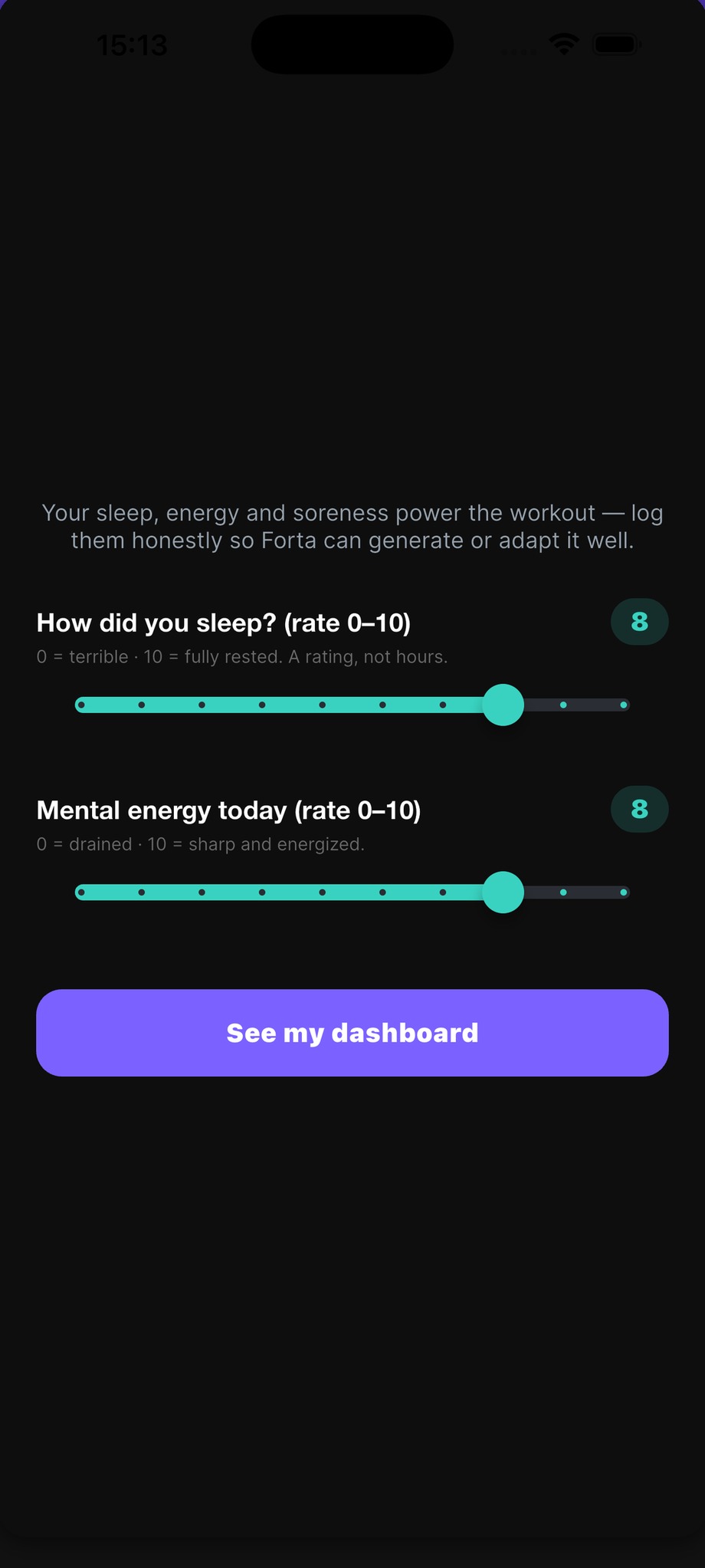
The check-in

The check-in

Sleep and mental energy, 0–10. Ten seconds, once a day.
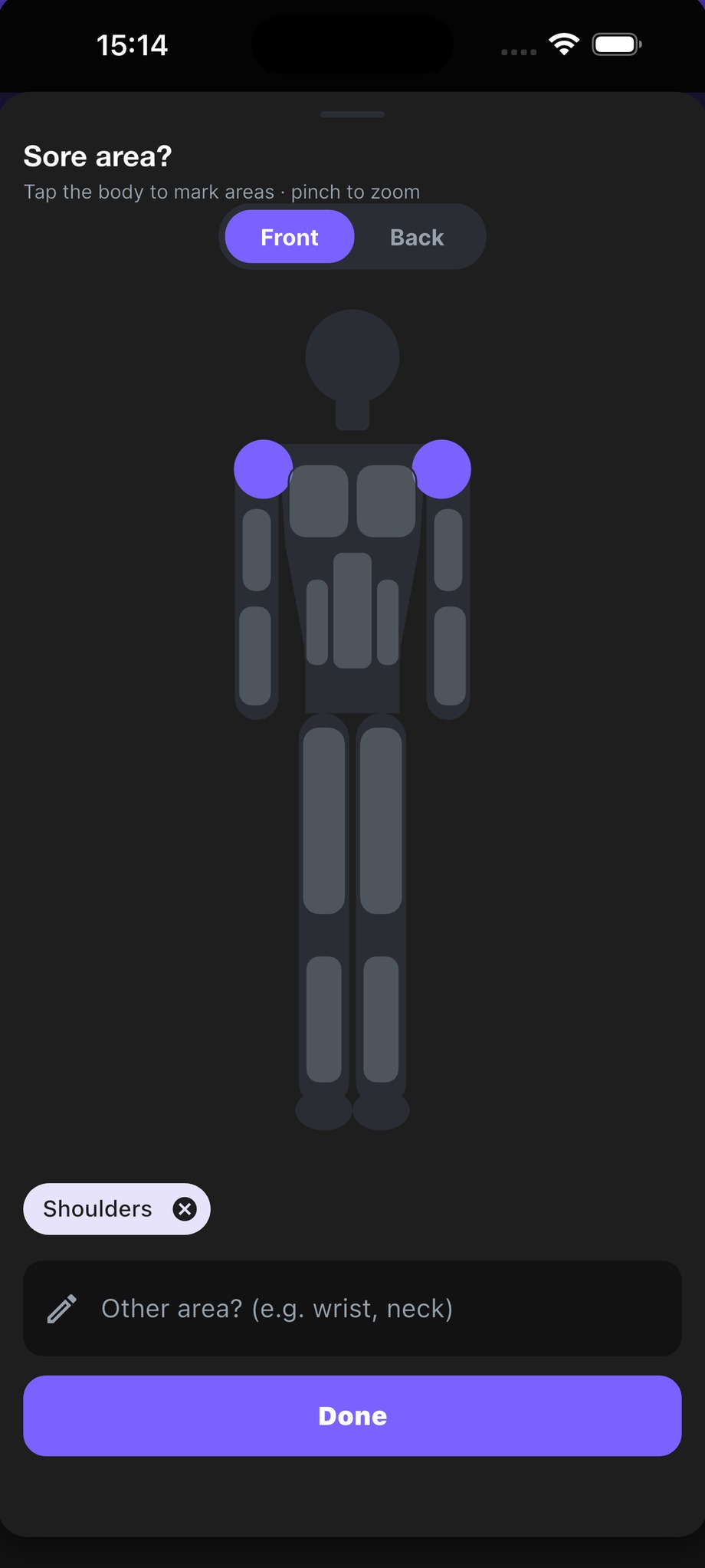
The body map

The body map

The player marks what is sore. The session is built around it.
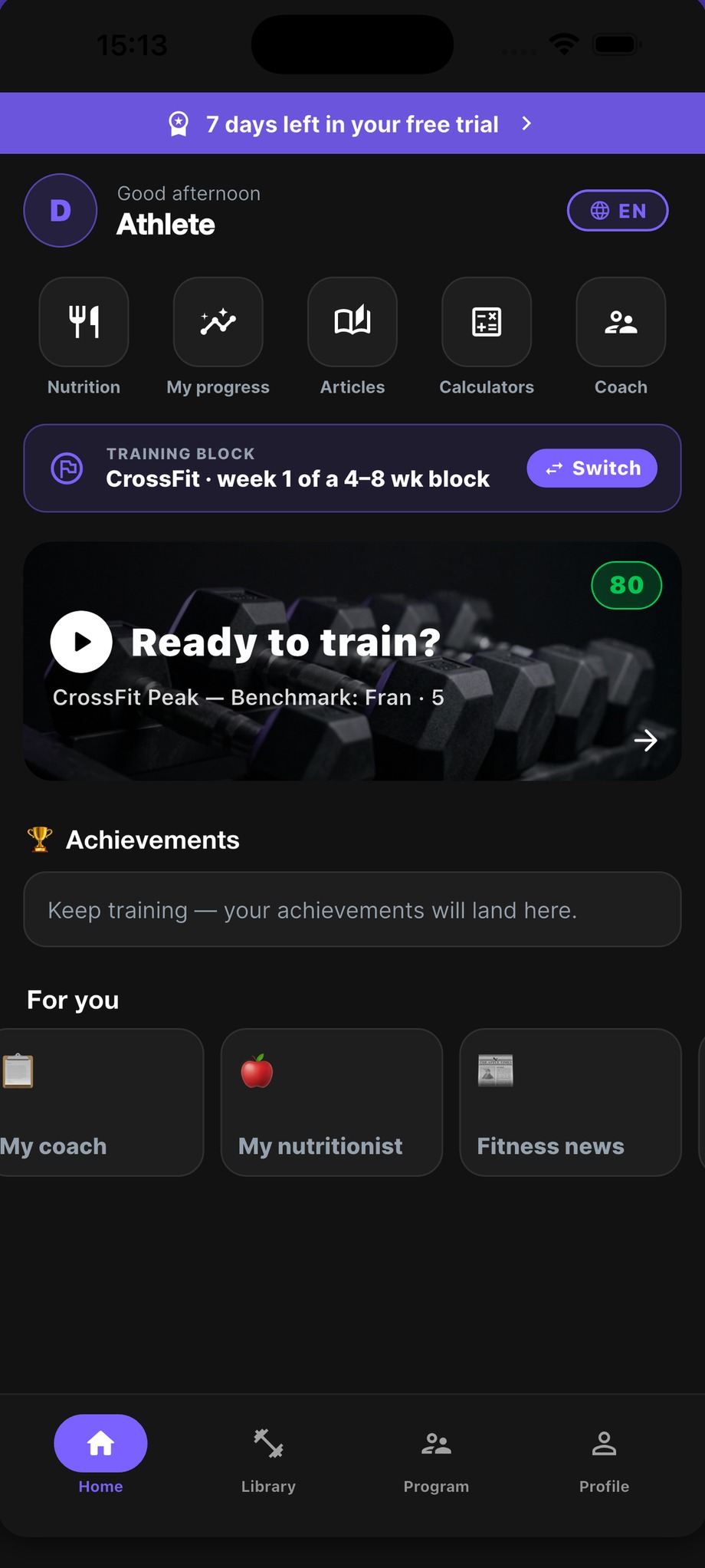
The readiness score

The readiness score

0–100, every morning, per player.
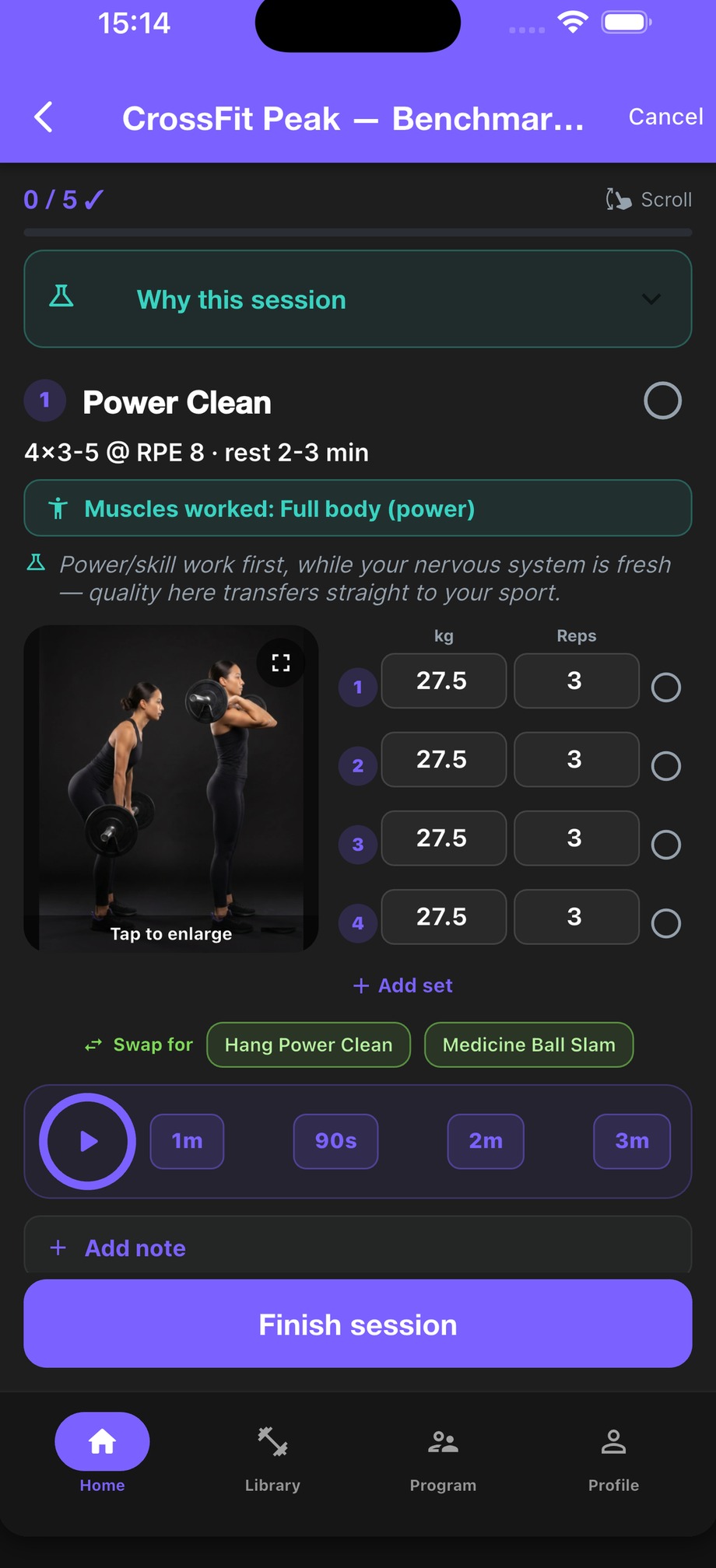
The session

The session

Built to the score, with the reasoning attached.

Athletes link to their coach with a code. Staff see readiness, recent sessions and check-ins per player, with the athlete controlling what is shared. Roles are separated — a fitness coach and a nutritionist see different things.

The evidence

Where the thinking comes from

Internal and external training load: 15 years on

Impellizzeri, Marcora & Coutts — Int J Sports Physiol Perform, 2019

The framework this page is built on: external load is the work performed, internal load is the relative biological cost, and prescription requires both.

UEFA Elite Club Injury Study

Ekstrand and colleagues, ongoing since 2001

The longest-running injury surveillance study in elite football. Hamstring injury is consistently the most common single injury in men's professional football.

Nordic hamstring exercise and injury risk

van Dyk et al. — Br J Sports Med, 2019 (meta-analysis)

Pooled evidence that programmes including the Nordic hamstring exercise substantially reduce hamstring injury rates.

The Copenhagen adduction programme

Harøy et al. — Br J Sports Med, 2019 (cluster RCT)

A simple partner-based adductor programme reduced groin problems in male footballers.

Methodology, in full: 20 of the 272 movements were scored by hand from the peer-reviewed literature. A documented rules engine — isolation vs compound, axial load, stretch bias, technical risk under fatigue — applies the same logic to the remaining 252. These are working estimates you can contest line by line, not laboratory constants, and the site says so on every article.

Beyond the software

The Euro-Biomechanics Lab

Alfredo Silva — sports scientist, MSc Physical Education and MSc High Performance Training, club experience in youth football, currently completing the STATSports GPS course. Available for on-site and remote work alongside the software, billed by the day.

Speed & sprint mechanics

Video-based analysis of running mechanics, acceleration and top-speed technique, with a written intervention plan.

Injury-risk screening

Movement screening focused on the hamstring, adductor and calf, and the return-to-play decision.

Load audit

A review of your current monitoring — external and internal — and what the gaps are costing in availability.

Staff education

A session for your coaching staff on nervous-system cost, MD-1 decisions and congested-fixture planning.

Pricing

Licensed per squad, invoiced directly

No app-store cut, no per-player billing surprises. One licence covers the squad and the staff who read it.

Squad
€99/month
up to 30 athletes · full staff access · readiness, sessions, history
Academy
€199/month
up to 100 athletes · multiple staff roles · per-athlete consent controls
Club
€349/month
unlimited athletes · every age group · priority support and setup

Free pilot · 5 places

Five places. Two athletes each.

Not a season, not a squad — five coaches, two athletes each, at no cost. Enough to see whether a readiness score changes a decision you would otherwise make on feel. If it does, we talk about the squad. If it doesn't, you tell me why, and we are both better off.

How to reach me

Write in English, Portuguese or Spanish — whichever is easier. Tell me the club, the age group, and what you currently use to monitor load.

Start with the app

Forta is free to download on iOS and Android. Look at it before you talk to me — it is the fastest way to know whether this is worth fifteen minutes of your time.

forta.web.app